
AI gaming is a broad term for games and gaming systems that use artificial intelligence to understand players, generate content, control characters, interpret inputs or adapt the experience in real time. It includes familiar ideas such as computer controlled opponents, but the category is becoming much larger.
Traditional game AI usually works inside rules designed in advance. A designer creates behaviours, state machines, decision trees or scripted responses and the game chooses among them. Modern AI can add another layer: language models can interpret natural language instructions, generative systems can create text or visual content, and computer vision can understand information coming from a camera.
From scripted behaviour to responsive systems
A useful way to think about modern AI gaming is that the interface no longer has to be limited to buttons and menus. A player can speak, describe an action, move a physical object or ask a question in ordinary language. The system can interpret that input and respond in the context of the game.
This matters particularly for open ended games. Tabletop role playing games are built around players doing unexpected things. The interesting problem is not simply making an enemy stronger. It is helping the game react when the party ignores the prepared route, talks to an unplanned character or changes the world in a way the designer did not predict.
AI gaming can connect software and the physical table
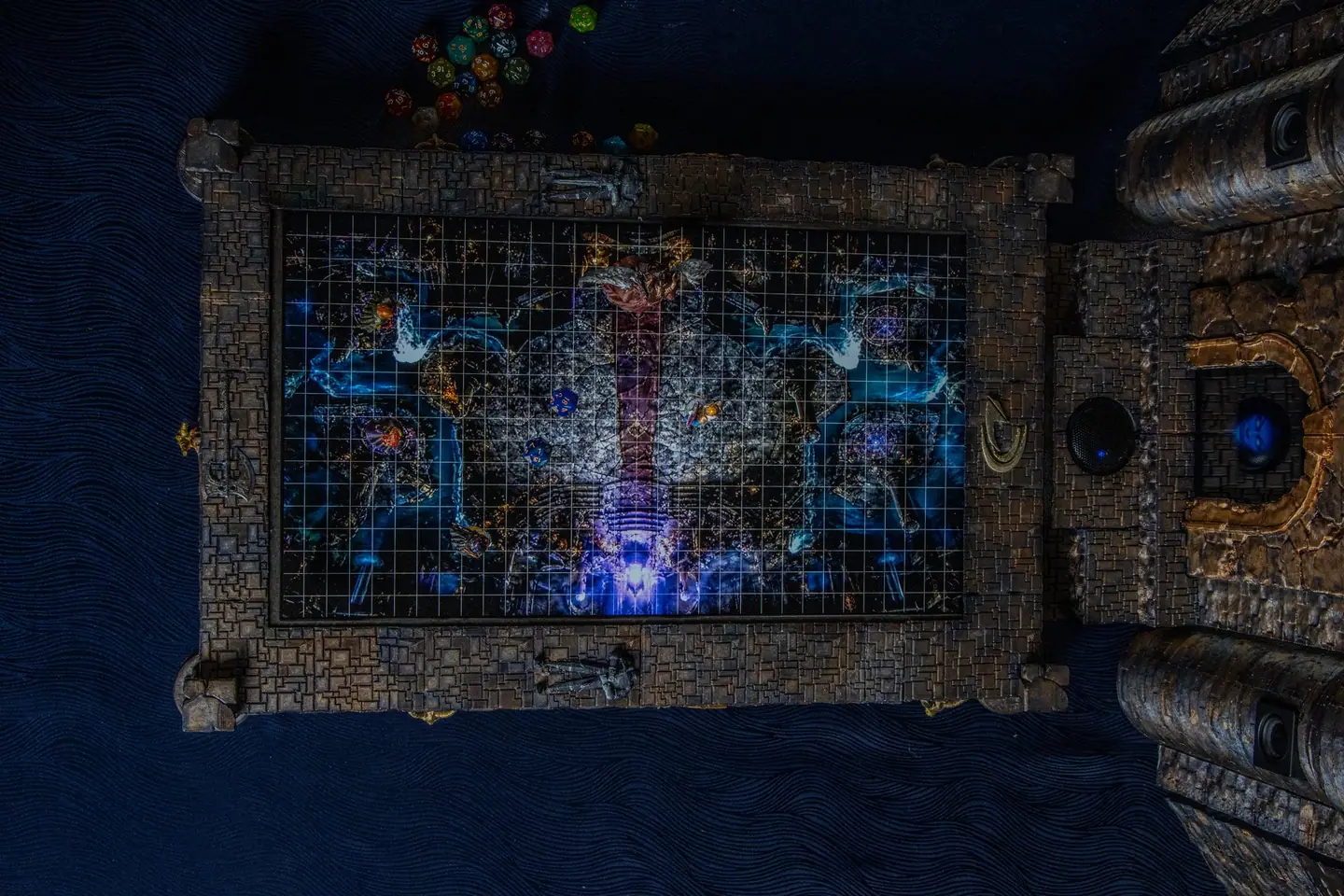
Realm Kinetics approaches this category through Doungim, a tabletop gaming console that combines software with physical play. The system is designed around real dice, miniatures, voice interaction, displays and camera input rather than asking the group to abandon the table for a conventional videogame interface.
That makes AI gaming less about replacing the human parts of play and more about giving the gaming environment new ways to understand what is happening.
AI gaming is therefore not one feature. It is an emerging stack of technologies: language understanding, generation, computer vision, audio, memory, rules and interfaces. The most interesting products will be defined by how those technologies work together around a real player experience.